
November 12, 2026
A property tax bill for a Rancho del Rey home usually carries a line most buyers skim past: an Open Space District assessment. For the 2026-27 fiscal year, the City of Chula Vista billed every Rancho del Rey zone at the highest amount the rules allow. The yearly increase is limited by an inflation formula, so the charge stays modest and predictable. When maintenance costs rise faster than that formula, the bill rises only by the allowed amount and the shortfall lands on the canyons, slopes and parkways the assessment pays to maintain.
If you are comparing Rancho del Rey with newer master-planned parts of Chula Vista, this is the piece of the cost picture a portal flag won't show you.
Most of Rancho del Rey sits inside Open Space District No. 20, which the City formed on December 5, 1989, with seven zones. Zone 8 was added in 1994 and Zone 9 in 1995. The older El Rancho del Rey subdivisions have their own districts, which date back further: OSD 1 from 1973, OSD 9 from 1977 and OSD 10 from 1978.
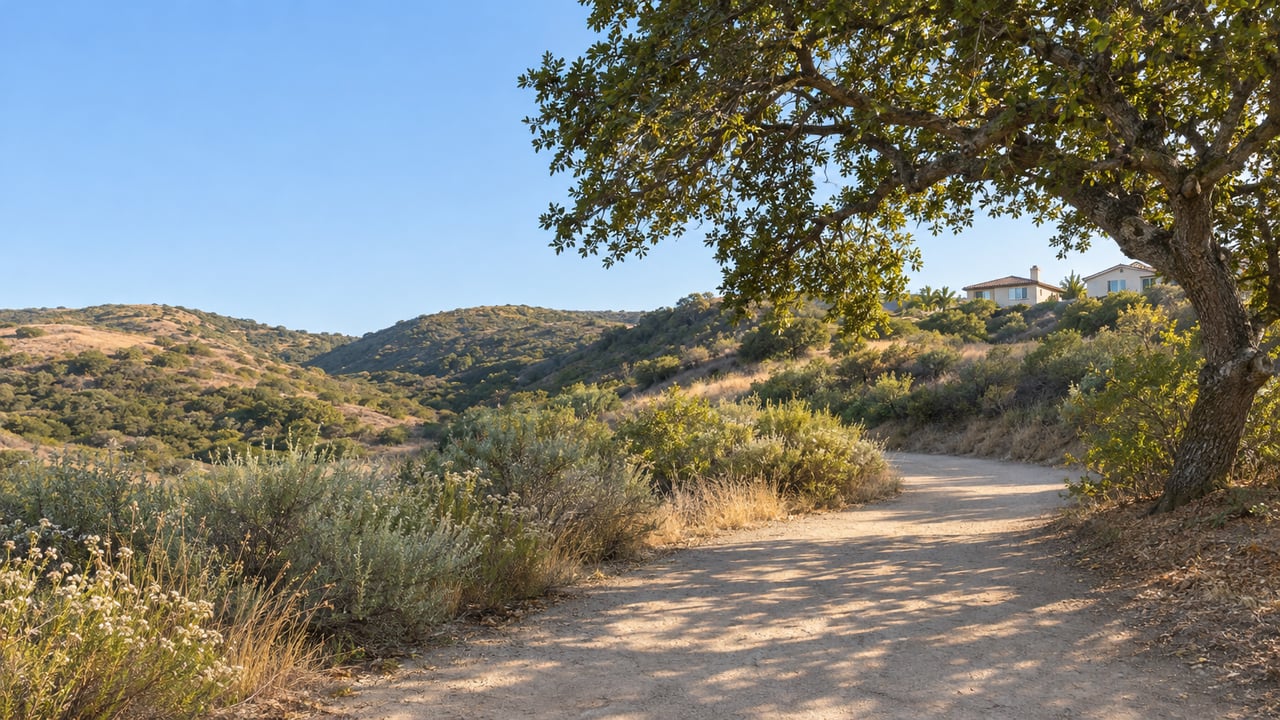
The City's OSD 20 page lists what each zone maintains. The list includes the Rice Canyon drop structures and desilting basin, the landscaping along East H Street, walls and landscaping along Otay Lakes Road, slopes along Telegraph Canyon Road, and a share of the Telegraph Canyon drainage channel. These are the green edges and drainage systems that give the neighborhood its canyon-and-slope feel.
The FY 2026-27 rates from the City's Final Engineer's Report are listed per equivalent dwelling unit, or EDU. An EDU is the report's billing unit and doesn't always equal one home.
| District / Zone | Area | Collectible per EDU | Maximum per EDU |
|---|---|---|---|
| OSD 20 Zone 1 | Desilting Basin | $90.21 | $90.21 |
| OSD 20 Zone 2 | Rice Canyon | $6.83 | $6.83 |
| OSD 20 Zone 3 | H Street | $9.75 | $9.75 |
| OSD 20 Zone 4 | Business Center | $75.02 | $75.02 |
| OSD 20 Zone 5 | SPA I | $548.26 | $548.26 |
| OSD 20 Zone 6 | SPA II | $421.25 | $421.25 |
| OSD 20 Zone 7 | SPA III | $260.02 | $260.02 |
| OSD 20 Zone 8 | N Desilting Basin | $59.93 | $59.93 |
| OSD 20 Zone 9 | Telegraph Canyon Channel | $47.59 | $47.59 |
| OSD 1 | El Rancho del Rey Units 1-4 | $167.50 | $167.50 |
| OSD 9 | El Rancho del Rey | $245.08 | $245.08 |
| OSD 10 | El Rancho del Rey 6, Casa Del Rey | $165.38 | $165.38 |
In every row, the two columns match. Which zones apply to a particular property depends on where it sits, so the parcel's own tax bill is the place to confirm its combination.
The ceiling moves each year by a formula in the City's Municipal Code. The new maximum is last year's maximum adjusted by the lower of the San Diego Metropolitan CPI or the change in California per-capita personal income from the Governor's January budget. For FY 2026-27, that factor was 2.62%, which was the January-to-January San Diego CPI change.
Going above that ceiling requires a property owner vote under Proposition 218. The City's Open Space page describes what happens in between:
"As fixed costs such as water increase greater than inflation, expenditures for other items often need to be reduced or eliminated to remain within budget (such as reducing the frequency of tree trimming) unless an assessment increase is approved by vote of the property owners pursuant to California Proposition 218."
A buyer gets a charge that can't jump, and the open space gets a budget that can only grow as fast as an inflation index, whatever the actual price of water, labor or desilting.
The Rice Canyon Trail Area, OSD 20 Zone 2, shows the effect most clearly. Its rate is $6.83 per EDU, spread across 3,957.82 EDUs, for a total levy of $27,046.03 in FY 2026-27. Total annual costs are budgeted at $22,711, up from $19,006 in FY 2025-26. Most of that increase comes from contractual services, which rise from $14,144 to $17,585.
The zone collects more than it spends this year, and the surplus goes into a reserve that is already below zero.
At this year's surplus, closing that gap would take roughly 15 more years, and that assumes no cost increases beyond the cap. The rate itself rose 2.62% this year, after a 3.81% increase the year before.
The larger residential zones carry more money and face the same squeeze. Zone 7, which covers SPA III, is projected to draw its operating reserve down from $151,427.50 to $88,189.77 during FY 2026-27. Zones 5 and 6, covering SPA I and SPA II, are drawing on their capital improvement balances, which are projected to end the year at $491,134.18 and $346,056.81.
Every Open Space District has a ceiling, but some collect less than their ceiling allows. The same engineer's report lists FY 2026-27 rates elsewhere in the city:
In those districts, the amount collected can still move up toward the published maximum. Every Rancho del Rey zone is already collecting its full maximum, which leaves reserves, reduced service and City support as the options the staff report names.
Newer parts of the city often add a second layer through Community Facilities Districts. San Diego County's FY 2026-27 roll of active CFDs includes districts in Otay Ranch, Eastlake and Millenia. The City's July 2026 CFD staff report explains that infrastructure CFD taxes repay bonds and maintenance CFD taxes pay for ongoing open space and facility upkeep. Of the City's 31 CFDs, 29 are active, and 28 are being levied this fiscal year. The City's district inventory doesn't list a Rancho del Rey facilities CFD. In Rancho del Rey, the City's open space charges are these older maintenance assessments. Other special taxes may still appear on a given bill, which is another reason to read the full bill line by line.
The Chula Vista City Council held the public hearing and adopted the FY 2026-27 levies on July 21, 2026. Resolution 2026-150 passed 5-0 and covered OSD 20 Zones 1 through 4, 6, 8 and 9. Zones 5 and 7 were adopted under separate resolutions.
The staff report for those levies put the total across all districts at about $4.4 million, matching roughly $4.4 million in landscape maintenance costs. It also warned that "due to rising costs of landscape maintenance services, several districts may need sustained General Fund financial support, reduced services in these areas, or a combination of both." Staff said this would be considered in developing the FY 2027-28 budget and that mid-year action is possible if needed.
For anyone weighing a Rancho del Rey purchase, the next thing to watch is the FY 2027-28 budget, where any General Fund support or service reductions for these districts would come up.
Can the Rancho del Rey open space assessment go up? Yes, but each year's increase is limited to the inflation factor in the City's Municipal Code, which was 2.62% for FY 2026-27. A larger increase would require a property owner vote under Proposition 218.
Does the assessment ever end? The City describes its Open Space Districts as funding perpetual maintenance through annual assessments, so they don't have a payoff date the way bond-backed charges do.
Is the per-EDU rate what one home pays? Not necessarily. The engineer's report bills by equivalent dwelling unit, and a property may sit in more than one zone, so the parcel's tax bill is the reliable number.
This post is general information, not legal, tax or financial advice. Please confirm how any assessment applies to your property with the appropriate professional.
If you're weighing a home in Rancho del Rey, Silvia Vasquez can go through the tax bill line by line with you and help you check what nearby open space a listing depends on, in English or Spanish. Schedule your free consultation, or start with an instant home valuation if you already own here and want to see where your property stands.
Stay up to date on the latest real estate trends.
Buying, selling, or investing—Silvia is here to walk with you every step of the way. Reach out today to experience a level of care, faith, and expertise that turns your real estate goals into lifelong success.
Submit a Message
PO BOX 1701 BONITA CA 91902 Silvia Inez Castro | CA DRE# 01447535